Showing posts with label pronoun. Show all posts

Thursday, July 2, 2015

Question Words (의문사) & Indefinite Pronouns (부정대명사)

Question words 5W1H

In English, there are 6 question words, 5W1H. And Same with English. There are 6 question words in Korean and usage is almost same.

* Question words 5W1H
Question form of copula is attached after a question word to make a sentence with a question words, and there must be a subject with particles to make a sentence complete.

* Usage of question words 5W1H

Question word 몇

Korean has a question word 몇(how many). The word cannot be used on its own but must precede a counter noun. For example, a specific question expression such as “how many people” would be 몇 명, “how many months” would be 몇 달, and so on. One can form various question expressions using the aforementioned counter nouns.

* Usage of question word 몇

Indefinite pronouns

People use indefinite pronouns when they refer to something that does not have a specific referent. In Korean, some indefinite pronouns are made of question words. The examples of indefinite pronouns in English include something, someone, sometimes, somewhere, anything, anyone, and so forth. Korean interrogative words such as 어디(where), 언제(when), 누구(who), 무엇(what), and 어느(which) function as question words as well as indefinite pronouns. What determines the use of these words as question words or indefinite pronouns is intonation.
When the word is used as a question, the sentence that contains the question word has a rising intonation at the end. However, without a rising intonation, the question word functions as an indefinite pronoun.


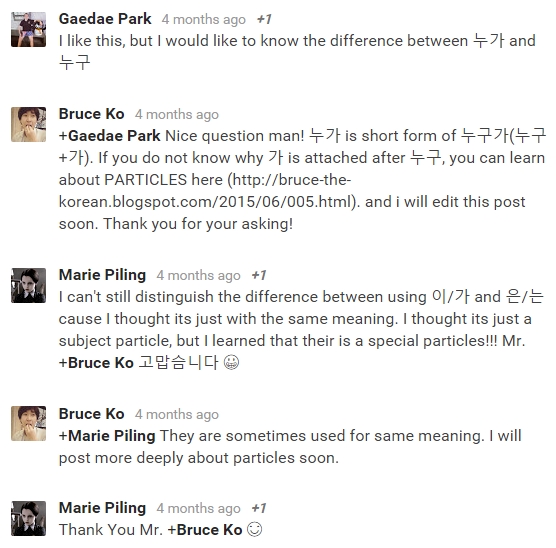
+Marie Piling

+Gaedae Park
* Click to read related posts
Grammar for Beginners
Endings of Sentences
Copula(Be & Be Not, 이다 & 아니다)
Particles Part.1 (What are the particles in Korean)
Counter Nouns (Numeral Classifier, 분류사)

* If you see any error in this post, let me know. Your help makes my blog better.


support me for better contents!!

Saturday, June 6, 2015

Personal Pronouns (인칭대명사)

English has an extensive list of pronouns. Korean has its own list of pronouns as well, but its usage is much limited with different usage rules. Generally speaking, pronouns are used much less in Korean than in English. In Korean, any contextually understood sentence elements, including the subject and the object, are often omitted. For instance, when two people are talking to each other, personal pronouns often drop out in normal conversations, since both speakers know who is the first person talking and who is listening. This differs from English, where the use of the pronoun or subject noun is mandatory in all situations. For instance, it would be grammatically wrong or incomplete to say “ate lunch?”

The First Person Pronoun

The Korean first person pronouns have the plain and humble forms:

* the first person pronouns
The use of either plain or humble pronouns depends on who you are talking to. It is always safe to use the humble form when you talk to adult speakers whom you do not know well. In addition, the use of humble form is normally collocated with honorific elements.

The Second Person Pronoun

The Korean second person pronouns have the plain and polite forms:

* the second person pronouns
The use of Korean second person pronoun is much more limited than that of English. For example, Koreans use 너 only when addressing a child, a childhood friend, one’s younger sibling, one’s son/daughter, and so forth. The use of 당신 is mostly used between spouses. Instead of using 당신 in actual conversation, we use professional title, honorific title, name, rank term, neutral title or ETC of them we are talking to.

The Third Person Pronoun

Strictly speaking, Korean has no true third person pronoun. Koreans use a demonstrative and a noun to refer to the third person:

He
그 “that,” 그 사람 “that person,” 그 분 “that esteemed person,” 그 남자 “that man” . . .

She
그 “that,” 그 사람 “that person,” 그 분 “that esteemed person,” 그 여자 “that lady” . . .

They
그들 “those,” 그 사람들 “those people,” 그 분들 “those esteemed people” . . .

* Click to read related posts.
Grammar for Beginners
Nouns(명사)

* If you see any error in this post, let me know. Your help makes my blog better.


support me for better contents!!