Showing posts with label 있다. Show all posts

Thursday, February 16, 2017

Auxiliary verbs IV (~어/아 있다, ~어/아하다, ~어/아지다)

~어/아 있다

The verb 있다 means “exist/stay/have”, as shown in the following examples:


As an auxiliary verb, ~어/아 있다 is mainly used with intransitive verbs and is used to indicate that the state brought about by the action of the main verb persists. Compare the following three sentences:


The first sentence simply states what Tommy does. The second sentence indicates the progressive action of the main verb. On the other hand, 어/아 있다 in the third sentence indicates that the state resulting from the main verb continues to exist. Consider another three sentences:


The first sentence simply indicates that the door opens. The second sentence indicates the progressive action. The third sentence, however, indicates the continuous state, brought about by the main verb 열리다(to be opened). Here are more examples of ~어/아 있다:


Meanwhile, a limited number of verbs of “wearing” do not take the ~어/아 있다 pattern but the ~고 있다 pattern to indicate the resultant state. For instance, to say “(I) am wearing socks” is 양말을 신고 있어요 not 양말을 신어 있어요.


~어/아하다

The aforementioned auxiliary verbs are all mainly used with verbs. However, Korean has a limited number of auxiliary verbs that are used primarily with adjectives, such as ~어/아하다 and ~어/아지다.
In English, one can state how another person feels, using emotion- or sense-related adjectives, such as “sad”, “happy”, and “cold”. For instance, it is grammatically correct to say a sentence like “Lisa is sad” or “Peter is cold”. However, in Korean, one cannot use adjectives to express how a third person or people feel or think. Since Korean emotive and/or sensory adjectives denote unobservable internal feelings, a speaker cannot speak for how other people feel or think. Consequently, a sentence like 리사가 슬퍼요(Lisa is sad) is grammatically incorrect.
In order to speak for a third person’s or people’s feelings or emotions, one has to change an emotive or sensory adjective into a verb form, using the auxiliary verb construction ~어/아하다, as shown below:


For instance, compare the following three sentences:


Notice that when the subject of the sentence is the third person, a verb 피곤해하다(feel tired) is used instead of the adjective 피곤하다(be tired). In addition, note that unlike other auxiliary verb compounding structures that normally require a space between the main verb and the auxiliary verb, as in 열어 놓다(open for later), ~어/아하다 does not leave a space between the main adjective and 하다 . This is due to the Korean spelling convention.
Meanwhile, when speaking of another person’s emotion or feeling in the past tense, one can use an adjective. This is because the speaker could have information about the third person’s internal feeling. Consider the following examples:


Notice that 슬펐어요 as well as 슬퍼했어요 are both acceptable, since both refer to the third person’s feeling in the past tense.

~어/아지다

The verb 지다 means “bear/owe”, as shown in the following examples:


However, as an auxiliary verb, ~어/아 지다 is typically used with an adjective, and it is used to express a gradually intensified change that occurs in the meaning of the adjective. It can be translated as “become/begin to be/get to be” in English. For instance, compare the following two sentences:


Notice in the second sentence that ~어/아지다 changes the adjective 춥다(cold) into an intransitive verb, 추워지다(becomes cold). In addition, the auxiliary verb ~어/아지다 adds the meaning of progressive change in the meaning of the adjective. Moreover, just like ~어/아하다, ~어/아지다 does not leave a space between the main adjective and 지다. Here are more examples:


* Click to read related posts.
Grammar for Intermediates
Irregular verbs and adjectives (불규칙동사와 형용사)
Auxiliary verbs I
Auxiliary verbs II
Auxiliary verbs III
Auxiliary verbs IV

* If you see any error in this post, let me know. Your help makes my blog better.


support me for better contents!!

Friday, January 27, 2017

Auxiliary verbs III (~어/아 주다, ~어/아 놓다, ~어/아 두다)

~어/아 주다

The verb 주다 means “give”, as shown in the following examples:


However, as an auxiliary verb, ~어/아 주다 means “do something as a
favor (for someone)”.


Compare the following two sentences:


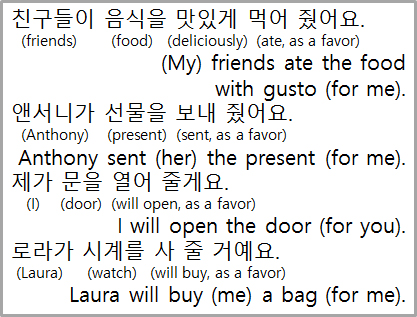
Notice that the first sentence simply expresses that David came to the party. On the other hand, the second sentence signifies that David came to the party for the benefit of the speaker or somebody. Here are more examples:


However, one can optionally use 위해서(on the behalf of) when wishing to explicitly state who the beneficiary was.


~어/아 드리다 vs. ~어/아 주다

Meanwhile, if the beneficiary of the action is an esteemed person, ~어/아 드리다 is used instead of ~어/아 주다. Compare the following two sentences:


The second sentence with ~어/아 주다 is inappropriate since the beneficiary of the action is an esteemed person. Here are more examples:


Requesting ~어/아 주세요

The verb 주시다 is the honorific form of 주다. ~어/아 주세요 is used when requesting something politely. It is equivalent to “please do (something for me/someone)”. Compare the following two sentences:


Both sentences can be used for requesting. However, the second sentence with ~어/아 주세요 is more polite than the first sentence. Here are more examples:


~어/아 놓다(or ~어/아 두다)

The verb 놓다 means “release/place/put down”, as in:


However, as an auxiliary verb, what ~어/아 놓다 can express is twofold. First, ~어/아 놓다 is used to indicate the continuation of a certain action or state after the completion of the action or state. For instance, compare the following sentences:


The verb 켜다 means “turns on (an electric lamp)”. Notice that the action of the main verb 켜다 is completed for both sentences, since they are marked by the past tense. However, while the first sentence simply indicates the past action, the second sentence with the auxiliary verb ~어/아 놓다 indicates the continuation of the completed action. Here are more examples:


Second, ~어/아 놓다 means “doing something for later (future use)”. Compare the following two sentences:


Notice that the first sentence simply indicates the past action, 마셨어요(drank). However, the auxiliary verb ~어/아 놓다 in the second sentence indicates that the past action was done for later. Here are more examples:


Alternatively, the verb 두다 can be used instead of 놓다. The verb 두다 means “place/keep”, as shown in the following examples:


As an auxiliary verb, the meaning of ~어/아 두다 is similar to that of ~어/아 놓다. In fact ~어/아 두다 and ~어/아 놓다 can be used interchangeably, as shown below:


* Click to read related posts.
Grammar for Intermediates
Irregular verbs and adjectives (불규칙동사와 형용사)
Auxiliary verbs I
Auxiliary verbs II
Auxiliary verbs III
Auxiliary verbs IV

* If you see any error in this post, let me know. Your help makes my blog better.


support me for better contents!!

Wednesday, September 9, 2015

Progressive Form (-고 있다)

The progressive form is used to express an action in progress. The English progressive form takes a copula (am, is, are) and a verb with “-ing”, as in “John is sleeping”. The Korean progressive form takes -고 있다. For instance, consider the following sentences:


To express a past action that was in progress, the past tense marker 었/았 is added to the stem of 있다 as in, 책을 읽고 있었어요 “(I) was reading a book”. Here are more examples.


To express respect to the subject, the verb 계시다(-고 계세요) is used instead of 있다(-고 있어요).


To negate a progressive form, one can use either a short form negation or a long form negation. For example, 가게 문을 열고 있어요 “(They) are opening the store door” can be negated both in the short and long form:


* Click to read related posts.
Grammar for Intermediates
Endings of Sentences
Copula (Be & Be Not, 이다 & 아니다)
Past tense and double past tense (과거시제)
Negation (부정문)

* If you see any error in this post, let me know. Your help makes my blog better.


support me for better contents!!

Saturday, July 4, 2015

The Verb of Existence and Location (있다 & 없다)

In English, the words “am”, “are”, and/or “is” can indicate that something is located or existing as in “There are Korean people” or “Seoul is in Korea”. For the verb of existence or location, Korean has the verb 있다 & 없다.

Existence and Location

The Korean verb 있다 means “exist/exists” or “there is/are”. For negation, Korean has a separate verb 없다 “do/does not exist” or “is/are not located”. Since 있다 expresses “something exists” or “something is located”, it is normally called the verb of existence and location.
When referring to a location of an object, you need a location, a locative particle “에”, and the verb of existence and location “있어요”. For instance, consider the following sentences.


Notice that the locations are marked by the particle 에, and they are followed by the verb 있어요.
For a more specific location reference, various Korean location nouns can be used. Korean has the following location nouns:

location nouns
Using one of the location nouns, you can be more explicit in referring to the location and/or position of the noun, as in 책이 책상 위에 있어요 “The book is on the table”.
You may wonder if these location words are like various prepositions in English such as “above”, “below”, “on”, “beside”, and “behind”. These English prepositions are similar to Korean location nouns in the sense that they both function to indicate the specific reference of the location. However, they are different in two aspects. First, while English prepositions always appear before the object of the location as in "above the table", those in Korean always appear after the object as in 책상 위(table-above). Another difference is that these Korean postpostional elements are nouns and they are normally followed by the locative particle 에, whereas English prepositional elements are not nouns.

The Use of 있다 & 없다 to Express “possession”

Another meaning of 있다 & 없다 is to express one’s possession. In the following example, 있다 & 없다 is better translated as “have/has”.


The literal translation of the above sentence may be “As for Peter, there is an Apple Computer” or “As for Peter, an Apple Computer exists”. However, it actually means(or is better translated into English) “As for Peter, (he) has an Apple Computer”. Notice that Apple Computer is marked by the subject particle 이/가. Some learner, whose native language is English, tend to make an error using 을/를 the object particle instead of 이/가. This is because of the native language transfer effect. They intuitively judge the verb “have” should have an object, since its direct English translation may be “Peter has an Apple Computer”.

* Click to read related posts
Grammar for Beginners
Endings of Sentences
Copula (Be & Be Not, 이다 & 아니다)
Particles Part.1 (What are the particles in Korean)
Negation (부정문)

* If you see any error in this post, let me know. Your help makes my blog better.


support me for better contents!!